How AI, Global Supply Chains, and Localized Service Capabilities Are Redefining the Future of B2B Business
Introduction: AI Is Driving a Fundamental Transformation in B2B Business with Strong Local Service Requirements
For decades, the traditional global B2B business model has followed a simple path:
Product Supply → Price Competition → Transaction Completion
Companies gained market advantages through Manufacturing capability ,Cost efficiency and Supply chain advantages. This model played a critical role in global industrial development. Especially in China, a complete industrial ecosystem and strong manufacturing capabilities have enabled global customers to access competitive products across multiple industries.
However, from the perspective of capitalist production systems, the organic composition of capital has been continuously increasing. From a financial perspective, this implies that the marginal return on social investment tends to decline over time. From a capital structure perspective, each unit of variable capital increasingly requires the support of a larger amount of constant capital.
The manifestation of economic development and value circulation is that individual economic entities increasingly operate and manage a greater number of physical assets and productive resources. This evolution is determined by the underlying logic of economic development and the structure of capital accumulation.
From the perspective of industrial evolution and customer needs, the rapid development of Artificial Intelligence (AI), renewable energy, smart manufacturing, automation, and digital infrastructure is fundamentally reshaping how businesses create and deliver value.
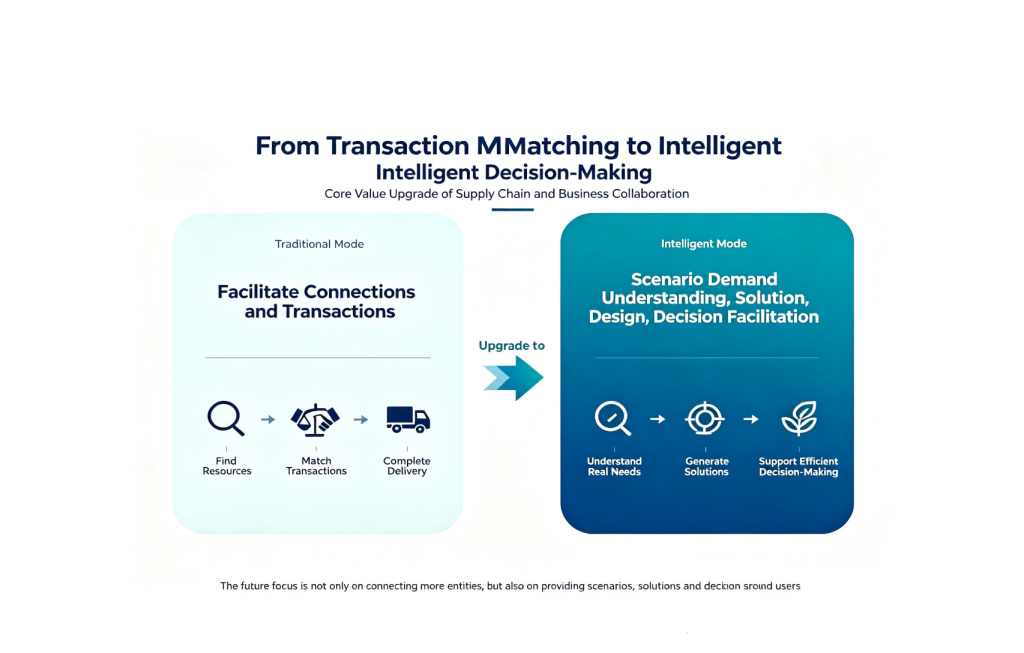
Future customers will not simply buy standalone products. They will increasingly demand integrated solutions, system capabilities, and service ecosystems that address their complete operational challenges.
Isolated product → Systematic Service
1 AI Era B2B Demand Is Shifting from Individual Products to System Solutions
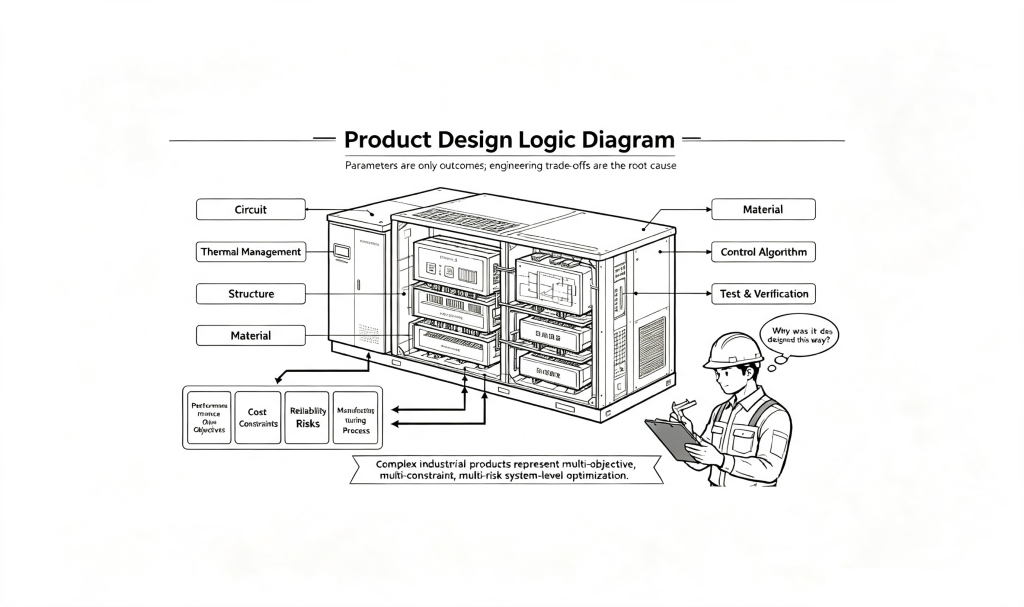
In the past, customers mainly needed a machine, a component and a specific product. Suppliers provided product quotations, technical specifications and delivery services.However, in increasingly complex application scenarios, a single product rarely creates sufficient value independently.
For example, when a company develops an energy system, it must consider energy sources, energy storage, capacity, power reliability, energy management and Long-term maintenance.
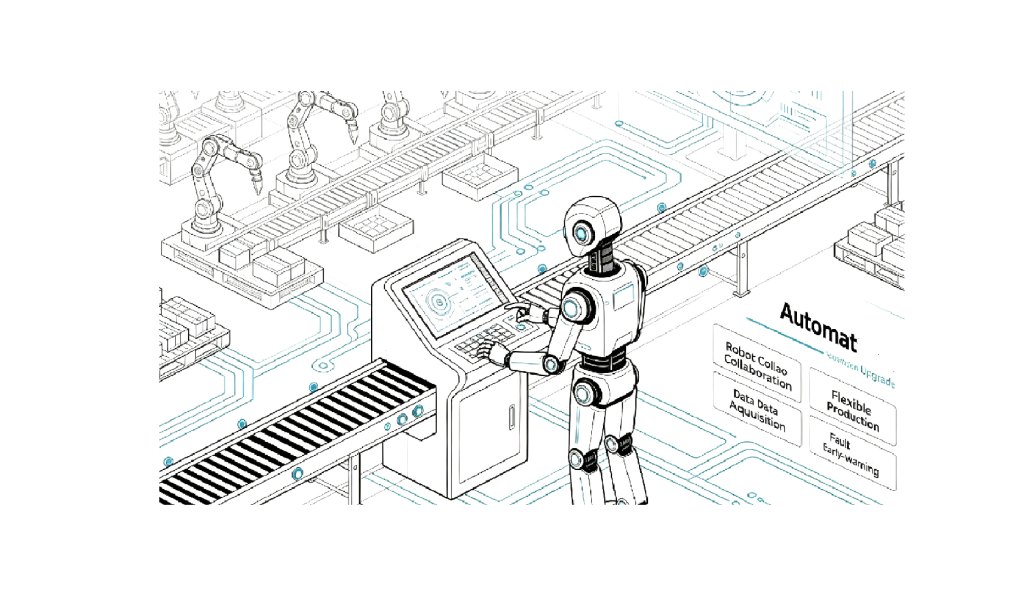
The customer is not simply purchasing a battery, they are purchasing an integrated energy solution. Similarly, a smart manufacturing factory requires coordination among perception systems, AI computing ,automation equipment, motion and actuation systems and software platforms.
The future competitive landscape of B2B business will shift from product competition to system capability competition, including scenario understanding, solution design, cost optimization, and sustainable, efficient after-sales service capabilities.
2 The Foundation of Smart Living in the AI Era: Energy × Perception & Computing × Motion & Actuation
Smart living will not be created by a single product. It will be built through the integration of multiple fundamental technology systems.
• Energy Systems: The Foundation of Intelligent Society. The core question is how can society obtain safer, more reliable, and more efficient energy.
• Perception & Computing Systems: Understanding the World Through Data. The core question is how can machines perceive, understand, and analyze the world.
• Motion & Actuation Systems: Turning Intelligence into action. The core question is how can intelligence create real-world impact.
The future development path of intelligent society can be summarized as:
Energy × Perception & Computing × Motion & Actuation → Smart Living
3 AI Will Not Replace People — It Will Enable Individuals and Small Teams to Develop System Capabilities once Limited to Large Enterprises
Many people believe AI will replace a large number of jobs. However, especially in B2B service industries, AI’s greater value is not replacement, but the capability expansion.
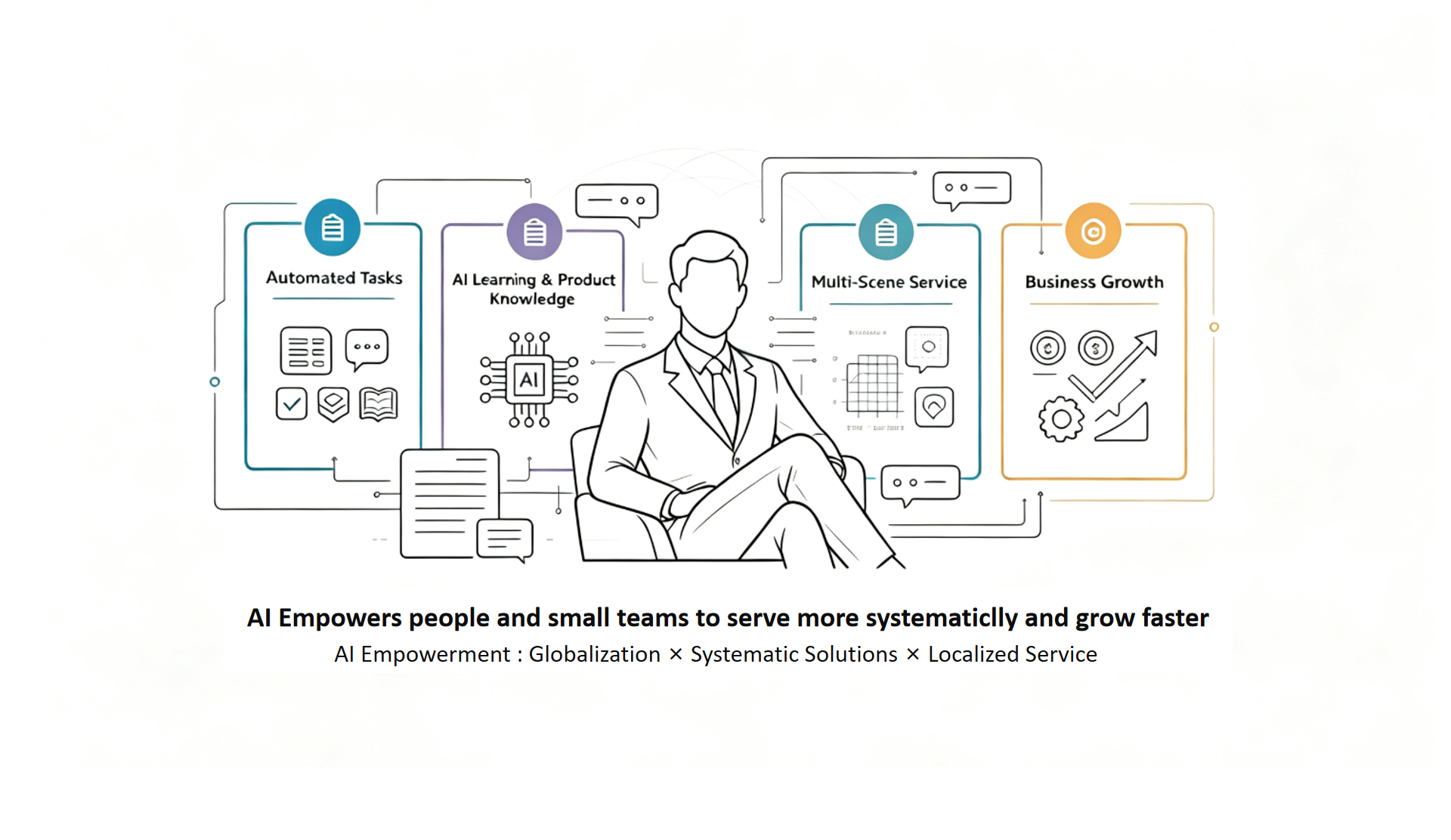
AI can not only automate time-consuming tasks such as information search, data gathering, and knowledge organization, which traditionally required significant human effort, but can also go beyond these functions by assisting with solution design and providing intelligent decision support.
Traditionally, providing systematic solutions required large teams, multiple departments and complex organizational structures.
However, AI is changing this structure. In the future, a professional individual or a small team can use AI tools to:
• Learn multiple industries faster
• Understand complex product ecosystems
• Integrate global supply chain resources
• Analyze customer requirements
• Develop comprehensive solutions
Future competition will not simply be about who has a larger workforce, but about who can enable customers to find the right partner with deeper understanding of their needs — while reducing the time, effort, and complexity involved in the process.
We believe that, with the power of AI, small teams will soon be able to achieve capabilities that were once only possible for much larger organizations.
4 Strong Offline-Service B2B Businesses Will Shift from Product Sales to System-Level Services
For many industries, especially, energy infrastructure, industrial equipment automation systems, engineering projects and smart manufacturing, the product itself represents only part of the total value, customers need more than equipment.
They need solution design, project planning, installation support, system commissioning, operation&maintenance and Local technical response.
Therefore, the future B2B business model will evolve from Product Seller(Product + Transaction) to System Solution Provider(Product + Integrated Solution + Service + Local Support).
AI reduces information barriers, but it cannot completely replace on-site implementation,engineering execution,local relationships and long-term service responsibility.
This creates new opportunities for:
• Local distributors
• System integrators
• Technical service providers
The key question is not whether these companies will upgrade.The question is ”Will they upgrade proactively, or will they be replaced by companies that successfully transform?”
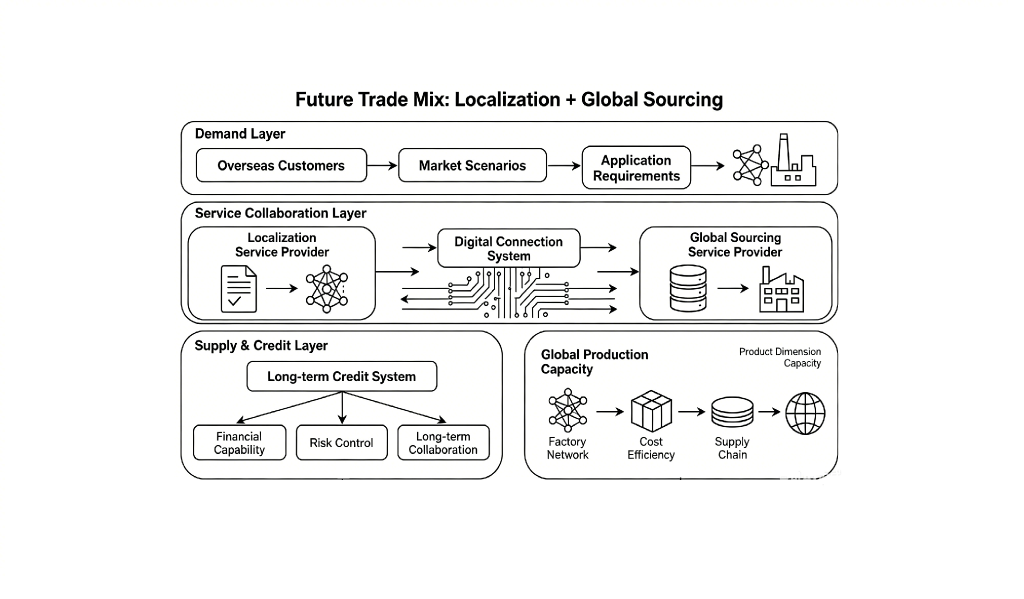
5 Global Supply Chains and Localized Services Will Become the Core Model of Future B2B Business
The future of global business is not a choice between globalization or localization,the real future model is “Global Supply Chain + Localized Service Capability.”
Global Supply Chains Provide:
• Manufacturing resources
• Product choices
• Technology options
• Cost advantages
• Production capabilities
China’s industrial ecosystem will continue to play an important role because of its:
• Complete supply chains
• Manufacturing depth
• Engineering capabilities
• Fast product innovation
Localized Services Provide:
• Application understanding
• Project execution
• Customer communication
• Installation support
• After-sales service
The combination of global resources and local execution creates a new B2B business model.This is the real meaning of “The global industrial internet.” A future industrial ecosystem where:
• Global supply connects resources
• AI connects knowledge
• Local teams connect customers
Conclusion: The Future of B2B Competition Is About System Capability, Not Just Product Sales
The biggest change brought by AI is not that machines replace humans.
The real transformation is:
AI enhances human capabilities and enables individuals, small teams, and companies to provide stronger systematic services.
Future B2B competitiveness will not only depend on who sells more products.It will depend on who can:
• Understand customer needs better
• Understand system connections deeper
• Integrate global resources more efficiently
• Provide closer local support
The successful companies of the AI era will combine Global Supply Chain Capability,AI-Powered Knowledge Capability and Localized System Service Capability together,.
These capabilities will define the next generation of global B2B business.