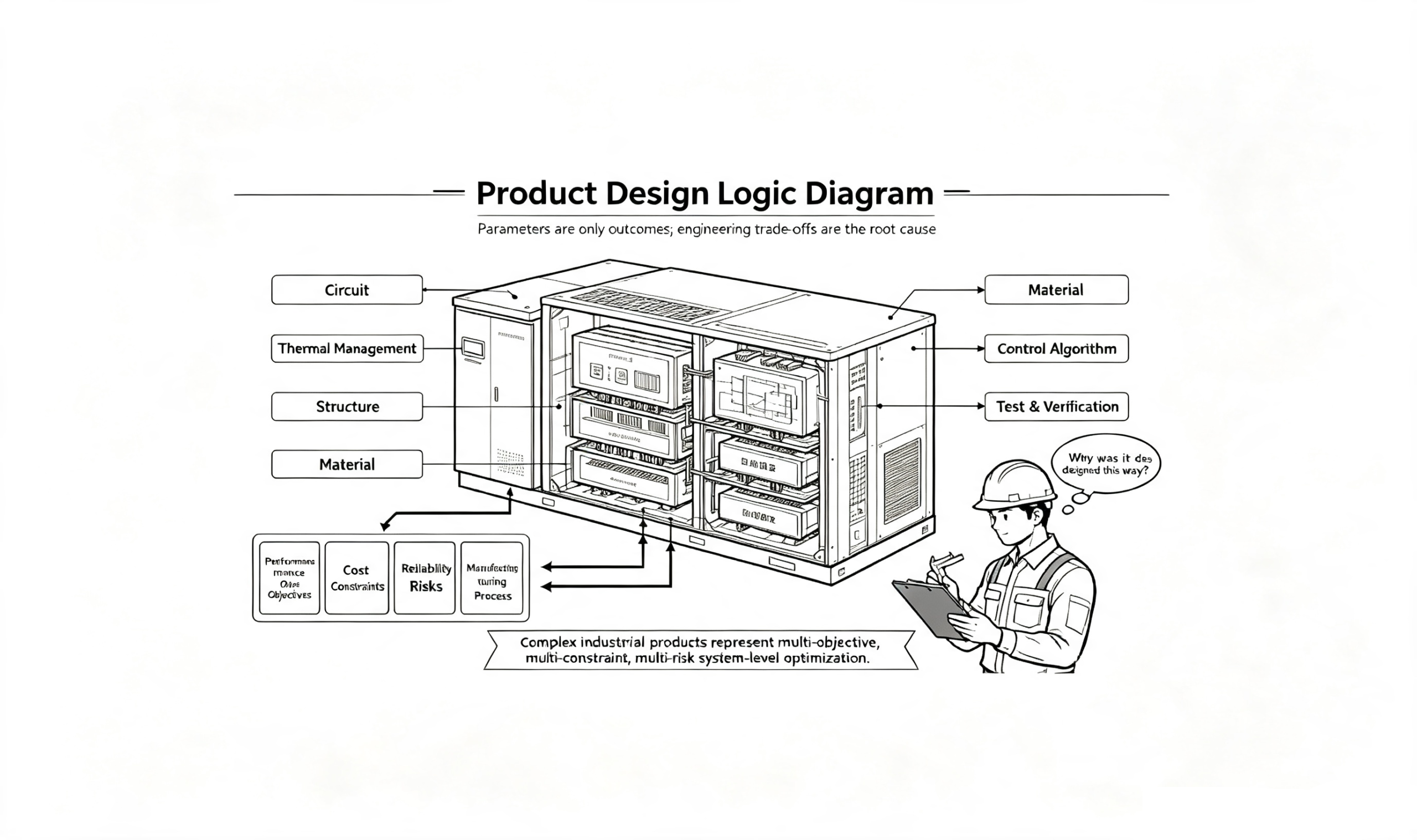
Introduction: Truly Understanding a Product Means Understanding Why It Is Designed This Way, Not Just Memorizing Specifications
In today’s rapidly developing global supply chain, industrial manufacturing, renewable energy, and artificial intelligence hardware industries, more and more professionals need to quickly understand unfamiliar hardware products.
Examples include:
• Energy storage systems
• Battery PACK systems
• Inverters
• Servo motors
• Robot components
• AI servers
• Industrial equipment
When many people start learning a new product, their first step is usually to read the product datasheet. They focus on specifications such as:
• Power rating
• Voltage range
• Energy capacity
• Material selection
• Certifications
• Performance indicators
These specifications are certainly important.However, knowing product parameters does not mean truly understanding the product.Because specifications are only the final results.
The real source of product competitiveness lies in the engineering logic behind these specifications.A professional understanding of hardware products requires deeper questions:
• Why was this product designed with these specific parameters?
• Why can certain specifications not be improved infinitely?
• Why do two suppliers with similar specifications provide completely different product value?
• Why can some products maintain stronger competitiveness despite having higher prices?
The answers behind these questions point to a fundamental principle of industrial products:Complex hardware products are essentially the result of engineering optimization under multiple objectives, limitations, and risks.
1. There Is No Perfect Product — Only the Best Solution for a Specific Application Scenario
Many people evaluate products by searching for the highest-performing option:
• The battery with the highest energy density
• The motor with the highest power output
• The equipment with the fastest operating speed
• The chip with the strongest computing performance
However, in the real industrial world, there is no product where every indicator is the best.The reason is simple:Improving one performance indicator usually creates new limitations elsewhere.
This is known as Engineering Trade-off.For example:
In automotive design, increasing engine power improves acceleration performance, but it also increases energy consumption, manufacturing costs, and thermal management challenges.
In smartphone design, improving computing performance increases processing speed, but it also creates higher power consumption, more heat generation, and greater battery pressure.
In industrial equipment, increasing operating speed improves production efficiency, but it can also increase mechanical wear and reduce long-term reliability.
Therefore, excellent products are not created by eliminating all contradictions.Instead, they are created by finding the best balance among multiple constraints.
2. The Essence of Hardware Product Design: Achieving the Target Function While Controlling Unwanted Side Effects
Every hardware product has a fundamental purpose.For example:
Battery:The core function is to store and release electrical energy.
Inverter:The core function is to convert electrical energy between different forms.
Motor:The core function is to generate controlled mechanical movement.
AI Server:The core function is to provide high-performance computing capability.
However, achieving these functions always creates secondary effects.The real competitiveness of advanced manufacturers comes from their ability to control these unwanted effects.A successful product is not simply one that achieves higher performance.It is one that improves the target function while maintaining:
• Safety
• Reliability
• Stability
• Efficiency
• Product lifespan
For example:
A battery manufacturer does not compete only by increasing capacity.The real challenge is:How can the company increase energy density while maintaining safety, cycle life, and long-term reliability?
An inverter manufacturer does not compete only by increasing output power.The real challenge is: How can the company achieve higher power density while controlling heat generation and maintaining system stability?
This is where engineering capability creates real product value.
3. The Core M3. The Core Method for Quickly Learning Hardware Products: Identify the Main Engineering Challenge
When learning a new hardware product, many people immediately dive into hundreds of technical parameters.A more effective approach is to understand the product from three fundamental questions:
Step 1: Understand What Problem the Product Solves
Before studying specifications, first understand: Why does this product exist?For example:
Energy Storage Battery:It is not simply a device for storing electricity.Its real purpose is to solve:
• Renewable energy fluctuations
• Grid stability problems
• Energy supply reliability
• Peak and off-peak electricity management
Inverter:It is not simply a device that converts current.Its real purpose is to solve:
• Energy conversion efficiency
• Grid connection stability
• Electrical safety
• System control requirements
Robot Motor:It is not simply a component that creates rotation.Its real purpose is to solve:
• Precise motion control
• High-efficiency operation
• Fast response
• Long-term stable performance
Understanding the application problem is the foundation for understanding the product.
Step 2: Identify the Key Performance Indicators
Different products have different indicators that determine their value.For example:
Battery:Energy density、Cycle life、Safety performance、Charging and discharging rate
Inverter:Conversion efficiency、Power density、System stability、Thermal management capability
Motor:Torque、Precision、Response speed、Operating lifetime
However, these indicators are only the surface.The deeper question is:Why do these indicators matter, and what engineering problems limit them?
Step 3: Identify the Core Engineering Trade-offs.
This is the most important step in quickly understanding a hardware product.Because product competitiveness is often hidden inside the ability to solve engineering conflicts.Every advanced industrial product exists because engineers have successfully managed difficult trade-offs. Understanding these trade-offs means understanding the real value of the product.
4. Case Study: Engineering Trade-offs Behind Battery Products
Battery technology is one of the best examples for understanding engineering trade-offs. Many people think battery competitiveness is mainly determined by capacity or energy density. However, the real competition among advanced battery manufacturers is not simply about increasing stored energy.It is about achieving the best balance among:
• Energy density
• Safety
• Charging speed
• Cycle life
• Cost
• Manufacturing reliability
4.1 Energy Density vs Thermal Stability
Every battery manufacturer wants to increase energy density.The reason is straightforward. Higher energy density means:
• Longer operating time
• Smaller product size
• Lower system weight
• Higher application value
For electric vehicles, higher energy density means longer driving range. For energy storage systems, higher energy density means higher capacity within the same installation space.However, increasing energy density also creates new challenges.When more energy is stored in the same physical volume, it creates:
• Higher thermal management requirements
• Greater safety risks
• More demanding material stability requirements
• Higher manufacturing control requirements
Therefore, excellent battery companies are not simply those that achieve the highest capacity.Their real capability is:Increasing energy density while maintaining safety, reliability, and long service life. This requires deep expertise in:
• Material selection
• Cell chemistry
• Battery structure design
• Thermal management
• Manufacturing processes
• Quality control
4.2 Fast Charging Capability vs Cycle Life
Modern users increasingly demand faster charging.However, achieving higher charging speed creates another fundamental engineering challenge.High-rate charging and discharging can lead to:
• Faster internal temperature changes
• Greater chemical stress inside the battery
• More aggressive interactions between lithium ions and electrode materials
• Faster material degradation
These factors can reduce battery lifespan.Therefore, fast charging capability and cycle life naturally create a trade-off.The goal of advanced battery manufacturers is not simply:"How can we make charging infinitely faster?"The real engineering question is:"How can we achieve faster charging while maintaining safety, durability, and long-term reliability?"
This requires balancing:
• Charging speed
• Battery chemistry
• Thermal control
• Material stability
• Cost
The best solution is not the maximum value of a single parameter. It is the optimal balance among multiple requirements.
5. Case Study: Engineering Trade-offs Behind Inverter Products
An inverter’s core function is to convert electrical energy.However, during energy conversion, energy losses occur and generate heat.This creates one of the most important engineering challenges: Power Density vs Thermal Management Capability.
Higher Power Output Creates Greater Thermal Pressure. Increasing inverter power capability provides:
• Higher output capacity
• Better system performance
• Wider application possibilities
However, higher power output also creates:
• More heat generation
• Higher component stress
• Greater cooling requirements
• Increased reliability challenges
If thermal management is insufficient, it can lead to:
• Reduced efficiency
• Shorter component lifetime
• Lower system stability
• Higher failure rates
Therefore, excellent inverter manufacturers do not simply compete by producing higher-rated power products. Their real competitiveness comes from achieving:
• High conversion efficiency
• Effective thermal management
• Compact design
• Long operating lifetime
• Stable performance under different conditions
The challenge is not increasing one number. The challenge is managing the relationship between multiple engineering factors.
6. Real Product Competitiveness Comes from the Ability to Reduce System Risks and Control Side Effects
Many companies believe product competitiveness comes from:
• Lower prices
• Higher specifications
• Larger production capacity
These factors are important, but for mature industrial products, true competitiveness comes from solving complex engineering problems.The strongest manufacturers are not necessarily those with the highest numbers on a datasheet. They are the companies that can achieve better overall performance in real-world applications. Example:
Excellent Battery Manufacturers
They are not necessarily those producing batteries with the largest capacity. They are companies that achieve better:
• Safety performance
• Cycle life
• Reliability
• Consistency
Excellent Motor Manufacturers
They are not necessarily those producing motors with the highest power output. They are companies that provide:
• Stable operation
• Accurate control
• Long service life
• Low failure rates
Excellent Industrial Equipment Manufacturers
They are not necessarily those with the fastest machines. They are companies that achieve:
• Continuous operation
• Low downtime
• High production reliability
• Predictable maintenance costs
The deeper principle is: Industrial competitiveness is the ability to manage complex relationships among performance, cost, reliability, and risk.
A company that understands these relationships can create products that deliver long-term value.
7. From a Supply Chain Perspective: Why Understanding Product Logic Matters More Than Knowing Prices
In international procurement, many buyers initially focus on one question:"Who can provide the lowest price?"However, professional supply chain management focuses on deeper questions:
• Why can this supplier achieve this cost?
• Why is this supplier’s product more reliable?
• Why can another supplier not easily replicate this capability?
• What engineering advantages support this supplier’s competitiveness?
A truly professional supply chain evaluation requires understanding four dimensions:
7.1 Product Logic
Why was the product designed this way?
What problems does the design solve?
What trade-offs were considered?
7.2 Manufacturing Logic
Why is the product manufactured through this process?
What production capabilities are required?
What technologies create quality differences?
7.3 Cost Logic
Why are supplier prices different? Is the cost advantage based on:
• Better manufacturing efficiency?
• Supply chain advantages?
• Material optimization?
• Production scale?
Or is it caused by:
• Lower quality materials?
• Reduced testing?
• Weak quality control?
7.4 Risk Logic
Why can one supplier deliver consistently while another cannot? Professional buyers evaluate:
• Manufacturing capability
• Quality systems
• Engineering experience
• Production stability
• Supply chain resilience
Because supply chain competition is not about finding the cheapest supplier. It is about finding the right manufacturing partner who can continuously create value.
8. A Five-Layer Model for Quickly Learning Any Hardware Product
When learning any industrial hardware product in the future, you can use the following five-layer framework. This method helps you move from basic understanding to professional product evaluation.
Layer 1: Product Function — What Problem Does This Product Solve?
The first question is always:Why does this product exist? Understand:
• What function does it provide?
• What problem does it solve?
• Why do customers need it?
For example:
A battery is not just a device that stores electricity. It exists because modern energy systems need flexibility, stability, and reliable energy management.
A robot servo motor is not just a rotating component. It exists because intelligent manufacturing requires precise, controllable, and reliable movement.
A semiconductor component is not just an electronic part. It exists because modern digital systems require faster computing, communication, and data processing capabilities.
Understanding the fundamental purpose of a product is the foundation for understanding everything else.
Layer 2: Application Scenario — Where and Why Is It Used?
A product cannot be evaluated independently from its application environment. The same product may have completely different requirements in different scenarios.For example:
A battery used in an electric vehicle requires:
• High energy density
• Lightweight design
• Fast charging capability
A battery used in industrial energy storage requires:
• Long cycle life
• High safety
• Stable operation for many years
A motor used in a consumer product may focus on:
• Low cost
• Compact size
• Quiet operation
A motor used in industrial automation may focus on:
• Precision
• Reliability
• Response speed
Therefore,there is no absolute best product. There is only the best solution for a specific application scenario.
Layer 3: Core Indicators — Which Parameters Determine Product Value?
After understanding the application scenario, identify the indicators that truly determine product performance. Not every specification has equal importance.Professional product analysis focuses on the parameters that directly influence customer value.For example:
Battery
• Energy density
• Cycle life
• Safety
• Charging performance
Inverter
• Conversion efficiency
• Power density
• Thermal performance
• Reliability
Servo motor
• Torque output
• Position accuracy
• Response speed
• Operating lifetime
The key is not memorizing every specification.The key is understanding: Which indicators determine whether the product can succeed in its target market.
Layer 4: Engineering Trade-offs — What Performance Conflicts Exist?
This is the most important layer. Every advanced hardware product contains engineering compromises. Examples:
Higher performance vs higher cost
Higher power density vs greater heat generation
Higher energy density vs greater safety challenges
Lower weight vs structural strength
Faster operation vs longer service life
Lower price vs higher quality requirements
Understanding these conflicts allows you to understand:
• Why the product is designed this way
• Why certain specifications have limitations
• Why different suppliers provide different value
• Where the real technical barriers exist
The difference between an ordinary product understanding and professional product understanding is the ability to see these hidden trade-offs.
Layer 5: Manufacturing Capability — Which Companies Can Actually Solve These Problems?
A product design is only meaningful when it can be manufactured consistently. The final competitive advantage comes from manufacturing capability.This includes:
Research and Development Capability
Can the company continuously improve product performance?
Process Capability
Can the company maintain stable production quality?
Material Control Capability
Can the company control key materials and components?
Quality Management System
Can the company ensure long-term product reliability?
Manufacturing Experience
Has the company solved similar problems through years of production?
Many suppliers can provide similar specifications.However, only experienced manufacturers can consistently deliver products that perform well in real applications.
Conclusion: Understanding Industrial Products Means Understanding How Manufacturing Solves Complex Problems
The fastest way to learn a new hardware product is not memorizing specifications.It is understanding:
• What problem the product solves
• Why customers need it
• Which indicators determine its value
• What engineering conflicts limit improvement
• How excellent manufacturers solve these challenges
Because there is no perfect product.There are only products that achieve the best balance among:
• Performance
• Cost
• Safety
• Reliability
• Manufacturing feasibility
In the future, global supply chain competition will not only be about finding the lowest-cost supplier.It will be about finding manufacturing partners who:
• Truly understand products
• Possess engineering capabilities
• Understand application scenarios
• Can continuously improve solutions
The core capability of excellent manufacturing companies is not eliminating all contradictions.It is the ability to continuously manage trade-offs and create better solutions under complex engineering constraints.